Reading Guide: Artificial Intelligence Applications and Innovations (AIAI 2022)
For researchers, graduate students and practitioners who want a map through applied-AI conference papers
Conference proceedings are not meant to be read like a novel, front to back. Artificial Intelligence Applications and Innovations, the Springer volume from the 18th IFIP WG 12.5 conference (AIAI 2022, held in Hersonissos, Crete, and online in June 2022), is a good example: hundreds of pages of peer-reviewed papers, edited by Ilias Maglogiannis, Lazaros Iliadis, John Macintyre and Paulo Cortez, each one a compact report on a specific problem. This guide helps you decide where to start, what to look for, and how to get real value out of a book like this.
Get the book: View AIAI 2022 on Amazon
What this book is (and who it's for)
AIAI is a long-running conference series of IFIP Working Group 12.5, and its proceedings are published by Springer in the IFIP Advances in Information and Communication Technology series. The emphasis, as the name says, is on applications: machine learning and other AI methods put to work on concrete problems in engineering, health, energy, networks and the humanities.
A note on which volume you are buying. Library and retailer records list this ISBN (hardcover 978-3-031-08332-7) as Proceedings, Part I of the main conference, roughly 520–560 pages. The publisher blurb that travels with the listing, however, describes the five workshops held in parallel with AIAI 2022, which Springer also published as a separate companion volume. If you need one specific paper, check the table of contents on SpringerLink before you buy.
Who will get the most from it:
- Graduate students looking for recent, citable applied-AI work and for ideas for a thesis topic.
- Researchers who want to see how others frame, evaluate and report applied ML results.
- Practitioners in health, energy or telecoms who want to know what methods are being tried in their field.
You should already be comfortable with the basics of machine learning: training and test sets, common model families (trees, neural networks, SVMs), and standard metrics such as accuracy, precision, recall and F1. This is not an introductory textbook.
Before you start
- Keep a notebook or spreadsheet with one row per paper: problem, data, method, baseline, metric, result, and your own verdict.
- Have a reference manager open (Zotero or similar) so you can save citations as you go.
- Accept that some papers will be outside your area. Skimming the abstract and conclusion is a perfectly good outcome for those.
How to read it
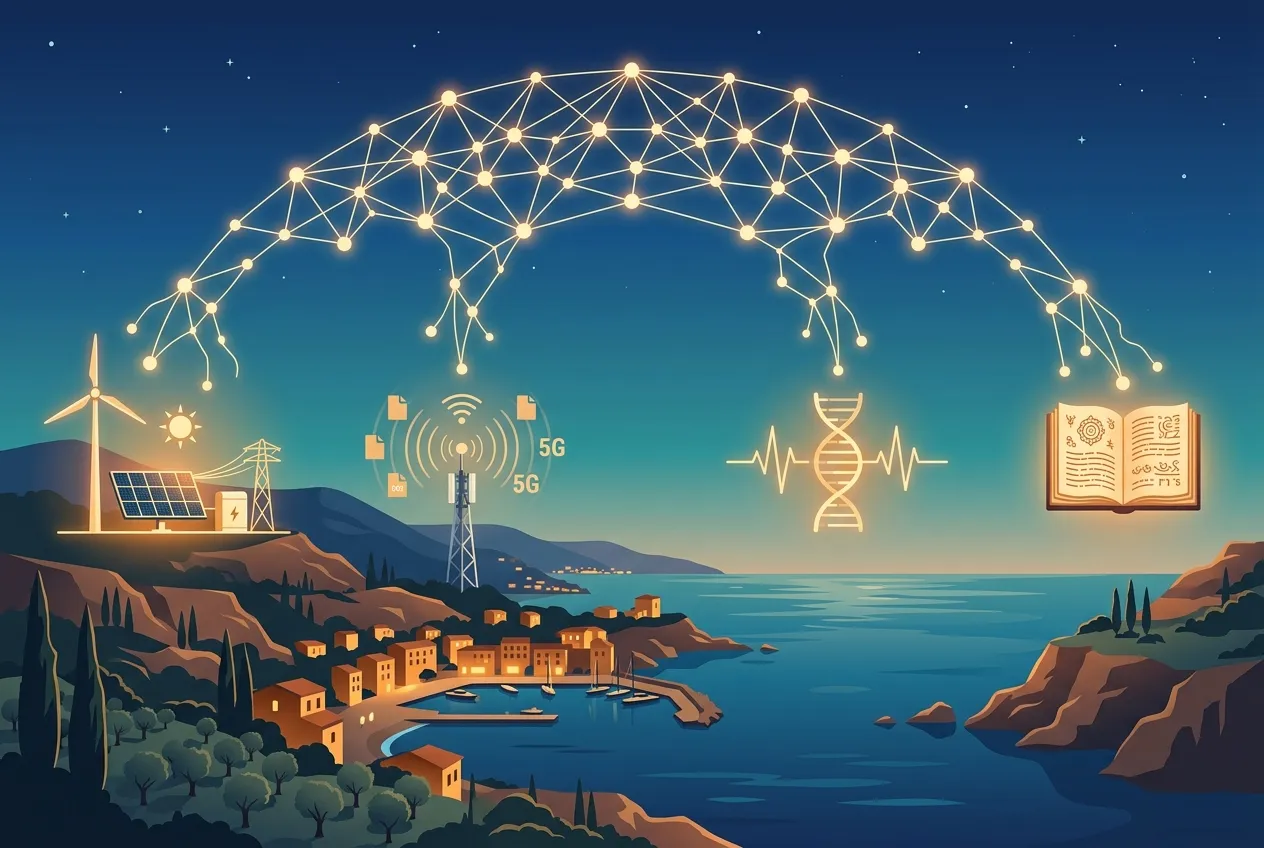
Organize your reading by theme rather than by page order. The publisher's description for this listing groups the material around five workshop tracks, which make a useful map:
- Mining Humanistic Data (MHDW 2022) — AI applied to text, culture, education and social data. Start here if you work in digital humanities or NLP.
- 5G and intelligence at the network edge (5G-PINE 2022) — ML for telecom networks and edge computing. A good entry point for engineers in networking.
- AI in Energy, Buildings and Micro-Grids (AIBMG 2022) — forecasting, control and optimization for energy systems. Pairs well with sustainability interests.
- Machine Learning and Big Data in Health Care (ML@HC 2022) — clinical and health-data applications.
- AI in Biomedical Engineering and Informatics (AIBEI 2022) — signals, imaging and biomedical data.
Suggested paths:
- First pass (one evening): read the preface and the table of contents. Mark every title that touches your field or a method you use.
- Second pass: for each marked paper, read the abstract, the figures and the conclusion. Drop the ones that don't hold up.
- Deep read: choose three to five papers and read them in full, focusing on the data and evaluation sections.
Health and biomedical readers can go straight to the health tracks; energy and sustainability readers to the micro-grid track; and anyone new to applied AI research may find the humanities and data-mining papers the easiest to follow, since the domains need less specialist background.
Key ideas to take away
- Applied AI is mostly about the problem framing. The interesting decisions are often how the data were collected, labelled and split, not which model was chosen.
- Baselines matter. A result means little without a fair comparison. Notice which papers compare against simple methods and which don't.
- Domain constraints shape methods. Edge devices limit model size; clinical settings demand interpretability; energy systems need reliable forecasts over time.
- Short conference papers trade depth for breadth. Treat them as pointers to ideas and follow-up work, not final answers.
Practice and discussion questions
- Pick one paper. Could its results be reproduced from what is written? What is missing?
- How large and how representative is the dataset in your chosen paper? Who might it leave out?
- Which papers report error bars, cross-validation or statistical tests, and which rely on a single run?
- In the health-related papers, how is the model's output meant to be used by a clinician?
- For an energy or network paper, what would it take to deploy the method in a real system?
- Find two papers that use similar methods in different domains. What transfers, and what doesn't?
- Write a one-paragraph follow-up study proposal based on the paper you found most promising.
Pair it with
- Research-paper reading skills: a structured method (such as a three-pass approach) makes proceedings far less intimidating.
- Experimental design and evaluation for ML: cross-validation, data leakage and fair baselines.
- Related volumes in our store: Advances in Artificial Intelligence Applications in Industrial and Systems Engineering and Artificial Intelligence for Environmental Sustainability and Green Initiatives cover neighbouring applied themes. Browse them on the Books Plus Ai shelf.
Closing thoughts
A proceedings volume rewards a reader with a plan. Pick a theme, read a handful of papers closely, and keep notes as you go. By the end you will have a clear picture of where applied AI research stood in 2022 and a list of ideas for your own work. Get AIAI 2022 on Amazon and start with the track closest to your interests.
As an Amazon Associate, BooksPlusAi may earn from qualifying purchases.
Sources
Browse the books mentioned here and more on our shelves.






Comments
No comments yet — be the first to share your thoughts.
Join the discussion